
Criminal Court Records in Warren County
A criminal court record is the official case file a court clerk opens the moment charges are filed against a defendant. In Warren County, the Circuit Clerk keeps the case files for Circuit Court and County Court, the two courts that handle most serious matters. The file grows as the case moves. Each filing, hearing, and order is logged in the docket. By the time a case closes, the record can hold the charging document, bond papers, motions, plea forms, the verdict, and the sentencing order. It is the single most complete account of what the court did with a charge.
Several courts hear criminal matters in Warren County, and the charge level decides which one. Circuit Court is the felony venue. It handles the most serious crimes, jury trials, and appeals from lower courts. County Court and Justice Court take lower-level cases, including misdemeanors, felony preliminaries, and citations from law enforcement. The City of Vicksburg Municipal Court handles city misdemeanors and ordinance violations. A felony case may begin with a preliminary step in Justice Court, then move to Circuit Court after a grand jury acts. For a closer look at the charges as filed, the Warren County court charge records page covers the charging side, and the broader Warren County court records page maps every case type.
The record is built by people, not by a machine. A typo, a delay in filing an order, or a sealed entry can leave gaps. Reading the case in full beats trusting a single field.
How to Search Warren County Criminal Court Records
Warren County does not run a single public website that searches every criminal case by name for free. The official online route is Mississippi Electronic Courts, viewed by the public through PAMEC, the Public Access to Mississippi Electronic Courts system. Circuit, County, and Chancery Courts file through it. Access is login-gated, so a free name-only search is not open to walk-in users. When the portal will not help, the Circuit Clerk records request form is the dependable fallback.
- Decide which court holds the case. Felony cases sit in Circuit Court, while smaller crimes may be in County, Justice, or Municipal Court.
- For Circuit, County, or Chancery matters, register for or log into PAMEC through the Mississippi Judiciary site.
- Search by defendant name or, much faster, by the case number when you have it.
- Open the case to read the docket entries, the charges, and the final disposition.
- Order a certified copy from the Circuit Clerk using the records request form, which requires the case number and the exact documents you want.
Some criminal records sit outside that path. For a City of Vicksburg citation or misdemeanor, call the Municipal Court clerk at 601-631-3742 or use the city online citation portal. Justice Court matters are handled at the Farmer Street office at 601-634-6402, which posts no online search. A seven-year background search runs through the Circuit Clerk for a flat fee, and the Mississippi Department of Corrections posts an inmate and parolee search for people in state custody. The Circuit Clerk does not keep transcripts, so those come from the court reporter.
Stages of a Warren County Criminal Case
A criminal case follows a set path, and each step leaves a mark in the record. The case opens with a charge. It ends with a sentence or a dismissal. Reading the docket in order shows how far a case went and what the court decided at every turn. In Warren County, felony cases run the full route through Circuit Court, where District Attorney Richard "Ricky" Smith Jr. prosecutes for the Ninth Circuit District.
Case flow: Charges Filed › Arraignment › Pretrial / Motions › Plea or Trial › Disposition › Sentencing
| Stage | What Happens |
|---|---|
| Charges Filed | The prosecutor files a charging document, or a grand jury returns an indictment, and the clerk opens the case file. |
| Arraignment | The defendant hears the charge in open court and enters a first plea of guilty, not guilty, or no contest. |
| Pretrial / Motions | Lawyers file motions, set bond, exchange evidence, and ask the judge to rule on issues before trial. |
| Plea or Trial | The case ends in a plea deal or goes to trial before a judge or jury, who decide guilt. |
| Disposition | The court records the outcome, such as a conviction, an acquittal, or a dismissal. |
| Sentencing | For a conviction, the judge orders the punishment and the terms are entered as the sentencing order. |
Not every case touches every stage. Many close with a plea before trial. Some are dropped at the pretrial stage and never reach a verdict.
What a Warren County Criminal Court Record Shows
The case file is built from many parts, and each field answers a different question. The Circuit Clerk request form treats the case number as the required anchor, so that number ties the whole record together. When you ask for a copy, name the exact document you need, such as the indictment, the judgment, or the sentencing order, rather than asking for everything.
| Field | What It Shows |
|---|---|
| Case Number | The unique court ID that links every filing in the case. Needed for any record request. |
| Defendant | The name of the person charged, along with party labels used by the court. |
| Charges | The crimes as filed by the prosecutor, with the level of each offense. |
| Docket Entries | The dated list of every hearing, motion, and order in the case. |
| Plea | The defendant's answer to the charge: guilty, not guilty, or no contest. |
| Disposition | The outcome of each charge, such as convicted, dismissed, or acquitted. |
| Sentence | The punishment ordered on a conviction, including jail, probation, fines, or costs. |
A few details are kept back even on a public copy. Social Security numbers, financial account numbers, minor names, and sealed entries are redacted or withheld before a file is released.
Warren County Charges vs. Convictions
Being charged is not the same as being convicted. A Warren County criminal court record can show charges that were later dropped, dismissed, or that ended in an acquittal. A charge is only an accusation. A conviction is a finding of guilt by plea or verdict. Reading the disposition is the only way to tell which one a record reflects.
| Charge | Conviction | |
|---|---|---|
| Stage | Accusation by the prosecutor | Verdict or guilty plea |
| Burden of Proof | Probable cause | Beyond a reasonable doubt |
| Can Be Dropped | Yes, before disposition | No, stands unless appealed |
| Public Record | Yes | Yes |
This gap matters for anyone reading a file. A long charge list does not prove guilt. The case may have closed with one plea and several dropped counts.
Reading Dispositions and Sentences
The disposition is the heart of a criminal court record. It states how each charge ended. A sentence follows only when the disposition is a conviction. Warren County criminal court files use the same set of terms found across Mississippi trial courts, so learning a handful of them makes most records readable.
- Guilty
- The defendant admitted the charge or was found guilty at trial.
- Not Guilty
- A judge or jury cleared the defendant of the charge.
- Nolo Contendere
- A no-contest plea that accepts the penalty without admitting guilt.
- Dismissed
- The charge was dropped; with prejudice it cannot be refiled, without prejudice it can.
- Deferred
- Judgment is held back while the defendant meets set conditions, often ending in dismissal.
A sentence can mix several parts. A judge may order jail or prison time, probation, a fine, court costs, restitution, or a treatment program. The sentencing order spells out the term and any conditions attached to it.
Sealed vs. Expunged Warren County Records
Two court actions can pull a criminal record out of public view, and they are not the same. A sealed record still exists but is hidden from ordinary public access. An expunged record is treated as though it never happened, and a public name search should no longer return it. Mississippi Code Section 99-19-71 is the core expungement statute, and the court of conviction handles the petition.
| Sealed | Expunged | |
|---|---|---|
| Visibility | Hidden from the public | Removed from public access |
| Law Enforcement | Limited access kept | Very limited references kept |
| Eligibility | Youth and certain protected matters | First-offender and select felonies, with waiting periods |
| Process | By statute or court order | Petition, fee, and a judge's order |
An expungement in Warren County begins in the court where the charge was filed. A felony goes through the Circuit Clerk, while a Justice, County, or Municipal Court matter may need to be filed in that original court.
Important: Warren County expungement filing fees run $85.00, $150.00, or $311.00, so ask the Circuit Clerk which amount applies to your offense before you file.
Public Access to Warren County Criminal Court Records
Most criminal court files in Mississippi are open to the public. The state's Public Records Act sets the baseline, and trial-court files are presumed available for inspection and copying unless another law restricts them. Warren County applies that rule through the clerk who holds the file. Circuit and County Court criminal records run through the Circuit Clerk, while a fee schedule covers search, copy, and certified-copy costs.
Key Statutes:
Mississippi Code § 25-61-1 et seq. - the Public Records Act makes government records, including most court files, open for inspection unless another law shields them.
Mississippi Code § 99-19-71 - governs misdemeanor and felony expungement, handled by the court of conviction.
The Circuit Clerk records request form sets the clearest local rules. A case number is required, a request is capped at five documents, and the clerk states 14 days to comply. Charges start at $15.00 per hour plus $1.00 per page, and mailed returns need a self-addressed stamped envelope.
Felony Prosecution and Drug Court in Warren County
Felony charges in Warren County are prosecuted by the District Attorney for the Ninth Circuit Court District, which covers Warren, Sharkey, and Issaquena Counties. District Attorney Richard "Ricky" Smith Jr. leads that office. The DA decides which charges to bring before the grand jury and how a case proceeds, but the court file itself stays with the clerk, so record requests go to the Circuit Clerk rather than the prosecutor.
Not every felony case ends in standard sentencing. The Ninth Circuit runs an Intervention Court, also called Drug Court, under Circuit Judge M. James Chaney Jr. It offers a structured rehabilitation track for eligible defendants who struggle with substance abuse inside the criminal justice system. A case routed through that program leaves its own trail of orders and status entries in the record. Details on eligibility, length, and program phases come from the court itself.
Federal Criminal Cases for Warren County
Not every crime is a state matter. Federal charges from Warren County are handled by the U.S. District Court for the Southern District of Mississippi, which places the county in its Northern Division at Jackson. These files are not kept by any Warren County clerk. They cover federal crimes, drug and firearm cases, and other federal-question prosecutions. The federal prosecutor is the U.S. Attorney for the district.
Background on the federal prosecutor's role is published by the U.S. Attorney for the Southern District of Mississippi.
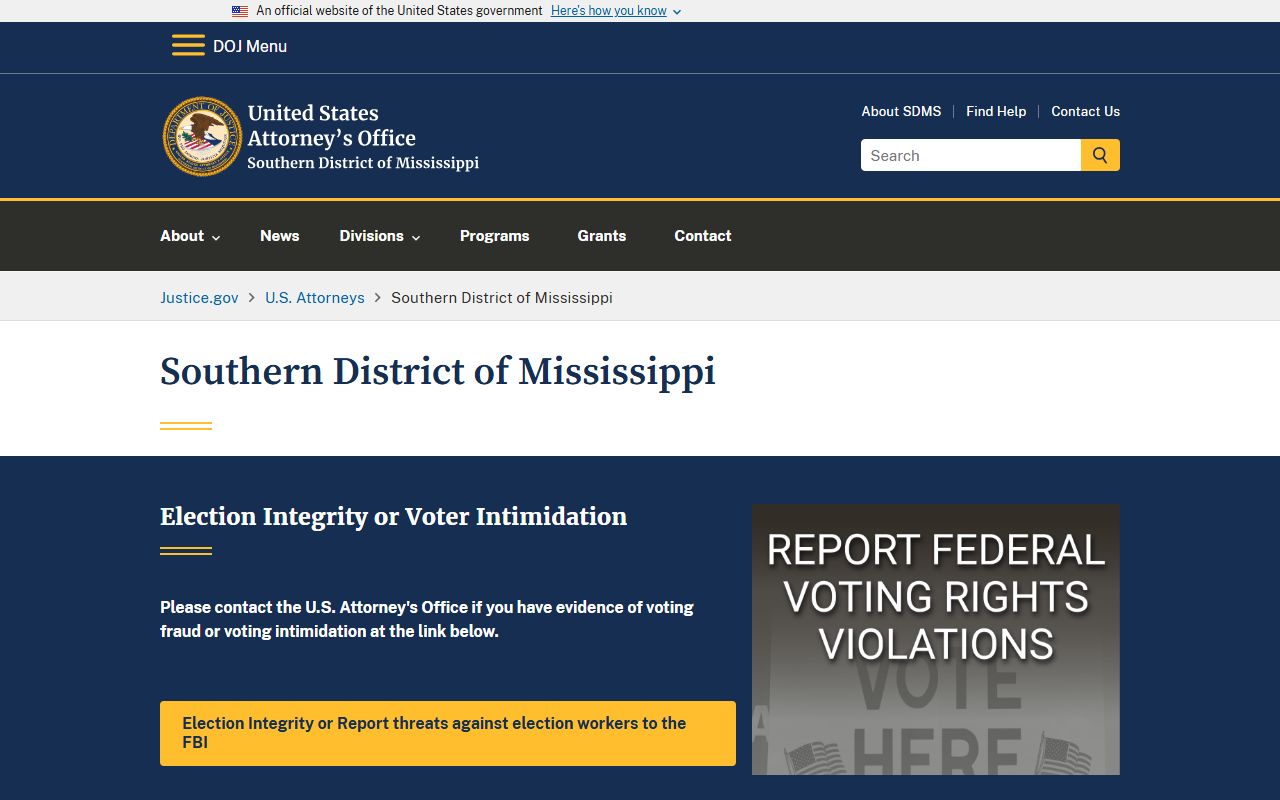
That office prosecutes federal crimes that arise in Vicksburg and the rest of Warren County, separate from the District Attorney's state cases. Anyone tracking a federal case needs the district court, not the county courthouse.
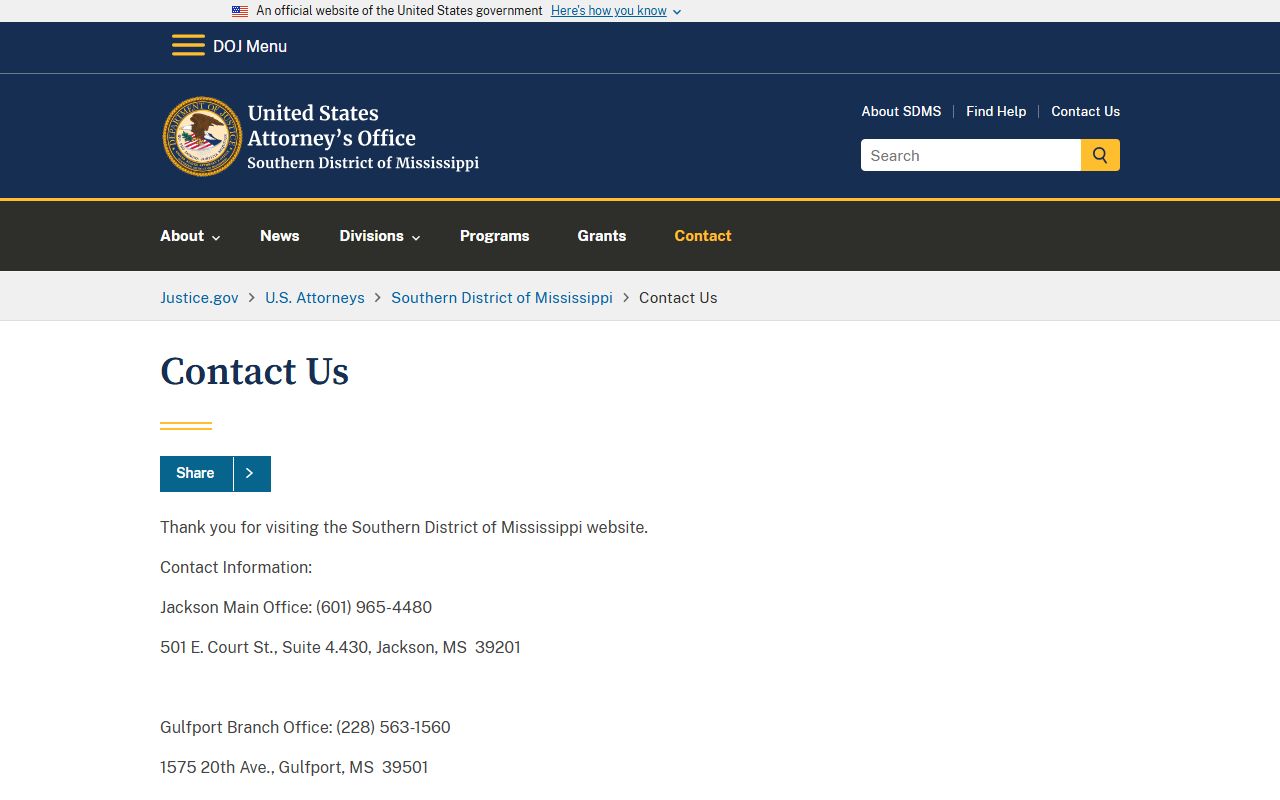
Office addresses and phone lines for the Jackson and Gulfport branches appear on the U.S. Attorney contact page.
Federal dockets and documents are searched through PACER, the official federal case-access service, rather than through PAMEC or a county clerk. Use it whenever a Warren County matter has moved into federal court.
Restricted Warren County Criminal Court Records
Some criminal court records are closed by law. Youth Court cases are the clearest example. Records involving children in Youth Court are confidential and released only to parties, attorneys, court officials, and people with statutory authority or a court order. Sealed and expunged cases also drop out of ordinary public access, along with adoption files, mental-health proceedings, and any entry holding sensitive personal identifiers.
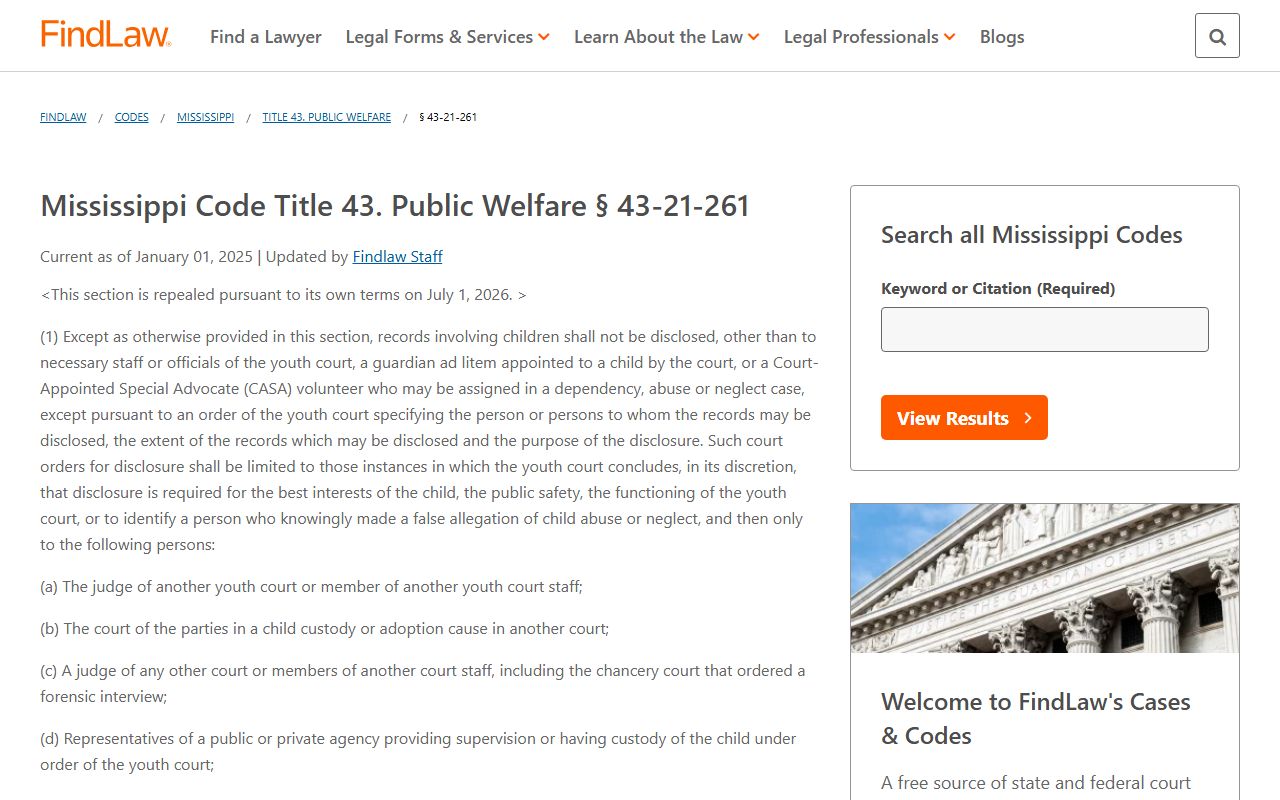
The confidentiality rule for youth records is set out in Mississippi Code Section 43-21-261.
Warren County Youth Court sits on Grove Street and is heard by Judge Marcie Tanner Southerland. A juvenile case will not surface in a routine criminal record search. For an adult case that is still open, some filings may be limited while the matter is active, so the clerk can confirm what is available for inspection.
Important: Warren County Court Records is not a consumer reporting agency, and these records cannot be used for credit, employment, tenant, or other FCRA-regulated screening.